
Daily Reading - 4/3/26
Judges 16:19-22
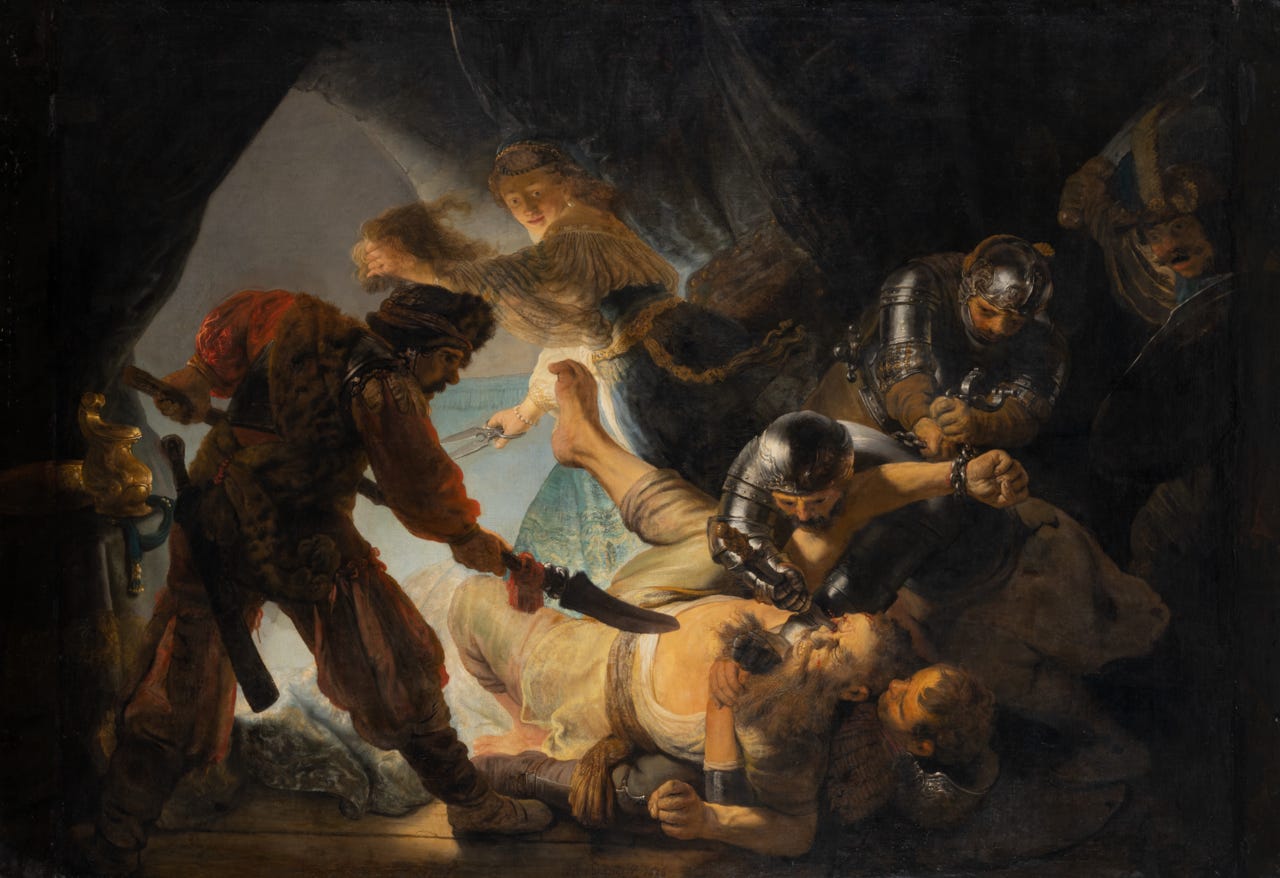
Above: Rembrandt, The Blinding of Samson. Netherlands, 1636.
Today’s Reading Plan:
And she had him sleep on her knees. And she called a man and had him shave off the seven locks of his head. Then she began to humiliate him and his strength left him. And she said, “The Philistines are upon you, Samson.” And Samson awoke from his sleep and said, “I will go out as before and shake free.” But he did not know that Yahweh had turned aside from him. And the Philistines seized him and gouged out his eyes and brought him down to Gaza and bound him with bronze shackles. And he ground at the mill in the prison. But the hair of his head began to grow after being shaved.
Judges 16:19-22
Today’s story continues the story of Samson, which began in yesterday’s readings. Samson is by far the most interesting and famous of the judges. Unlike most figures in the Bible—especially in the Old Testament—Samson is a narratively complex figure who displays character development. In many ways Samson feels foreign to the cultural context of Judges, and indeed to the Old Testament generally. The idea of long hair granting a heroic warrior supernatural strength would be more at home in Homer than in Moses.
And that is not accidental. It has long been speculated that the story of Samson is indeed modeled on Greek hero stories, and on the story of Hercules in particular. In the Greek Hercules legend, the eponymous figure was a mortal warrior who overcame great challenges and trials on his way to divinity. It seems that this basic narrative traveled from Greece to West Asia due to Greek colonization, and that it was used by the Israelites to tell about one of the tribe of Dan’s greatest warriors. On this reading, it is even possible that the “Shamgar” of 3:31 is the same person as “Samson.” The similarity of their names and careers argue in favor of identity, but the fact that they are given different named fathers (Anath vs. Manoah) weighs against it.
The specific geography of the story makes the overall reconstruction of Samson as a Hercules-like Greek hero more plausible. Samson was from the city of Zorah, of the tribe of Dan. At that time Dan was the south-westernmost Israelite tribe, directly bordering the land of the Philistines—today’s Gaza Strip. It makes sense, therefore, that the story of Samson is entirely about conflict between the Danites and the Philistines. As we discussed last week, the Samson narrative is a short scene in a story about overall Israelite defeat. The Danites would eventually lose the war and be driven far north, to the other extreme end of Israel.
It makes sense that Samson is described as a mythical Greek warrior, then, because the Philistines were themselves Greeks. They continued to worship the Greek gods, to maintain a Greek diet (with a preference for pork and watered down wine), and to produce Greek art. The Philistines had come as colonists from Greece, due to chaos back in the Greek homeland of the Aegean. They arrived by ship from the west and began their invasion of Canaan at almost the exact same time the Israelites did. As the Philistines conquered eastward from the ocean, the Israelites conquered westward from the desert. They met in the middle and—at that region of conflict and cultural exchange—they began to influence one another.
The mutual influence between Greek and Hebrew culture would continue through the centuries. It was under Greek influence, for example, that Hebrew authors began to write in a more familiar, “modern” feeling way. The novellas of Ruth and Esther, for example, were written under the influence of Greek novels—alongside other important influences. And sometimes, as with Samson, we can even detect specific Greek influences on the Hebrew literature of the Bible.