
Daily Reading - 4/4/26
Judges 17:6
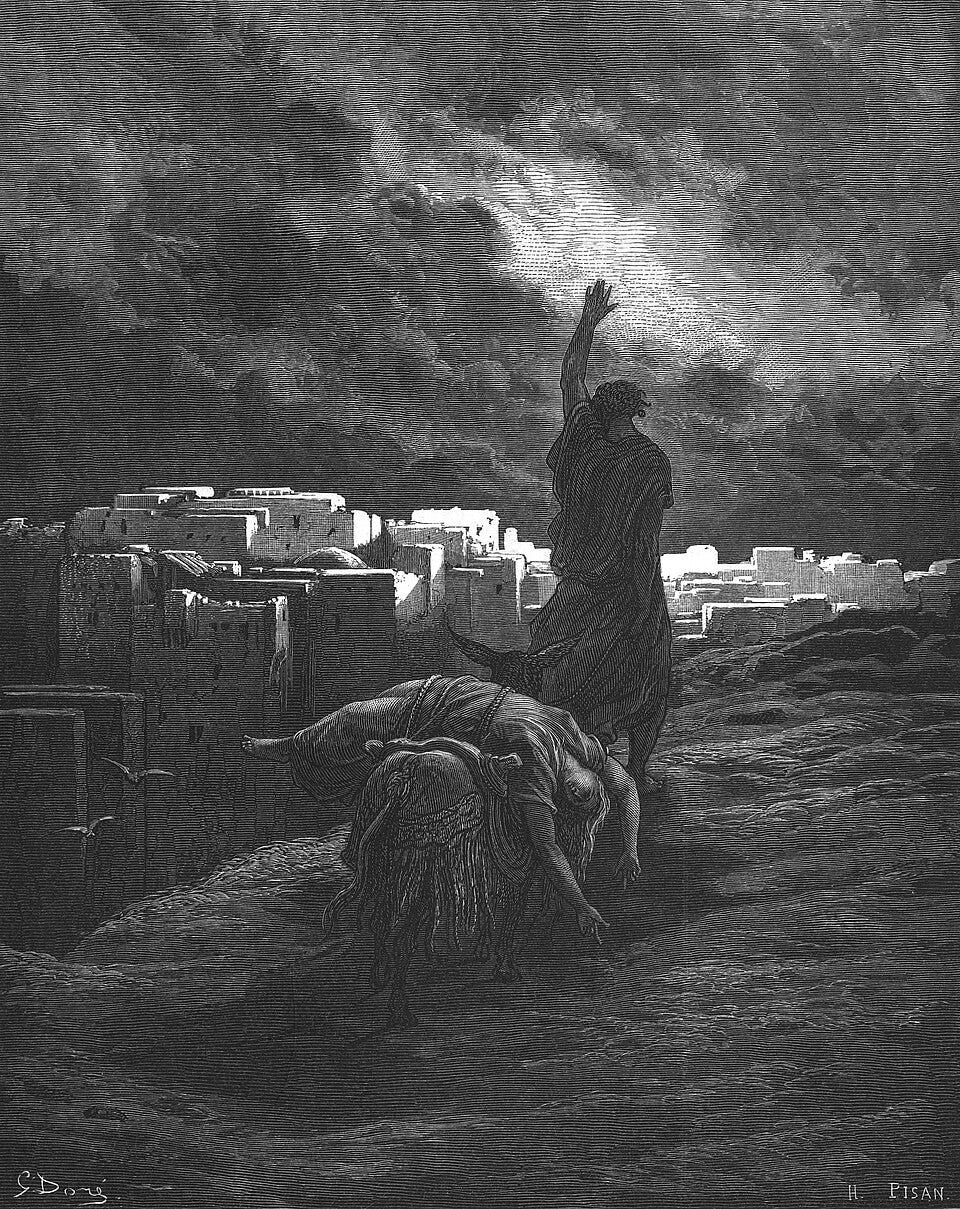
Above: Gustave Doré, Outrage at Gibeah. France, 19th century.
Today’s Reading Plan:
In those days there was no king in Israel. A person did whatever seemed right to him.
Judges 17:6
Note: This sentence is repeated, in whole or in part, in the following verses: 18:1; 19:1; 21:25.
We come now to the horrific beginning of the end of the book of Judges. Up to this point the book has been a diverse mixture of fun hero stories. Whether we listen to Deborah recite war poetry, watch Gideon test God with his fleeces, or hear the roars of the animalistic Samson, Judges has maintained an overall atmosphere of action-packed fun. That fun ends dramatically and sharply in chapter 17. From chapter 17 until the end of the book, the author of Judges tells some of the most depraved and haunting stories in the entire Bible.
Like the first part of any good horror story, a current of anxiety and tension flows beneath what seems to be a scene from ordinary daily life in chapter 17. We are introduced to an Ephraimite named Micah who, along with his mother, make an idol of silver to worship Yahweh with. At first Micah installs one of his sons as priest in the shrine that he builds (17:5), but later he hires a Levite (17:12). Now that Micah had a real, legitimate Levite priest in his little temple, he reasoned, God would certainly prosper him (17:13). This is meant to deeply unsettle the reader. Though Micah, his family, and the Levite are clearly pious in a way, they are so ignorant that they try to express their piety by sinning. In order to worship God, they make idols! This, according to the author, is what happens in an anarchic society where there is no king to enforce God’s Law.
But Micah would not long enjoy his sinful piety. As we have seen many times in previous readings, the Danites ultimately lost their war against the Philistines. Eventually Dan was forced to leave their allotted homeland in the south-west of Israel and move to the far north. Those Danites appear again in chapter 18. They had recently lost that war and were looking for a new land to settle in. On their journey northward they happened to pass by Micah’s house. Unfortunately for Micah, the Danites stole Micah’s idol, all of the contents of his shrine, and hired his Levite out from under him. The Danites then built a temple for Micah’s idol, and they installed another priest—one of Moses’ own grandsons—at the shrine. This is, once again, a good window into the religious degeneration of the society. None of them seem to have had any inkling of God’s demands for them in the Law. Even their most pious acts are profoundly sinful.
Chapters 19-21 then tell the darkest story in the entire Scriptures. For the sake of clarity, I will introduce chapters 20-21 alongside chapter 19 here. None of the main characters in this section are given a name. We are simply told that a Levite from Ephraim took a concubine, who then became angry with him and left him to return to her hometown of Bethlehem (19:1-2). The Levite then went to win her back over—which he did—and they began to return home (3-9). As they traveled back home, the man and his group stopped in the city of Gibeah—in the territory of Benjamin—to stay the night (10-15). The only person to offer hospitality to the group was an old Ephraimite who just happened to live in Benjamin (16-21).
The horror began that night over dinner. We are told that the men of the city surrounded the old man’s house and began to pound on the door. They demanded the visitor be brought out so that the men of the city could all rape him (22). Instead, the Levite pushed his own concubine out the door and everyone else stayed locked inside. We are told that they violently raped her until morning, and that she died at the threshold of the door the next day (23-27). When the Levite returned home he took a knife, dismembered her body into twelve parts, and sent one to each of the twelve tribes of Israel (28-30). In the most dramatic way possible, he summoned all of the Israelites to take vengeance for this heinous crime.
The next two chapters tell of the aftermath of the scene. In chapter 20 all eleven other tribes join together to fight against the city of Gibeah. At first they demand that Benjamin hand over the men of the city for punishment, but Benjamin refused. So war broke out between Benjamin and the other tribes. While Benjamin held out briefly, eventually they were defeated by the much larger coalition.
They were defeated so soundly, in fact, that the tribe almost did not survive. In particular, due to religious vows that the other tribes had taken, no one was willing to give his daughter to a Benjaminite in marriage. The tribe would thus eventually disappear. The rest of the Israelites devised two solutions to this problem. The solutions, however, were almost as horrific as the original crime. The first solution involved the women of an Israelite town named Jabesh-Gilead. Apparently the men of Jabesh-Gilead had not answered the call to war when they had been summoned (21:5). Because this was punishable by death, the Israelites decided to kill all the men and married women of Jabesh-Gilead, and to give the unmarried women to the Benjaminites as wives (8-14). These were not enough wives, though, so the Israelites devised a ruse to allow the Benjaminites to kidnap other Israelite women at an upcoming religious festival (15-24). That latter strategy is suspiciously similar to the Rape of the Sabine Women from Roman mythic history.
Now you understand why I described this section as the most horrifying set of chapters in the Bible. The author wrote this section as bleakly as possible, to drive home the overall message of the book of Judges. Here at the end what has always been implicit is brought out into stark relief. Even if the reigns of kings are tyrannical, it argues, the depredations of anarchy are far worse. The text then ends with its key refrain: “In those days there was no king in Israel. A person did whatever seemed right to him.”