
Daily Reading - 4/8/26
1 Samuel 1:1-3
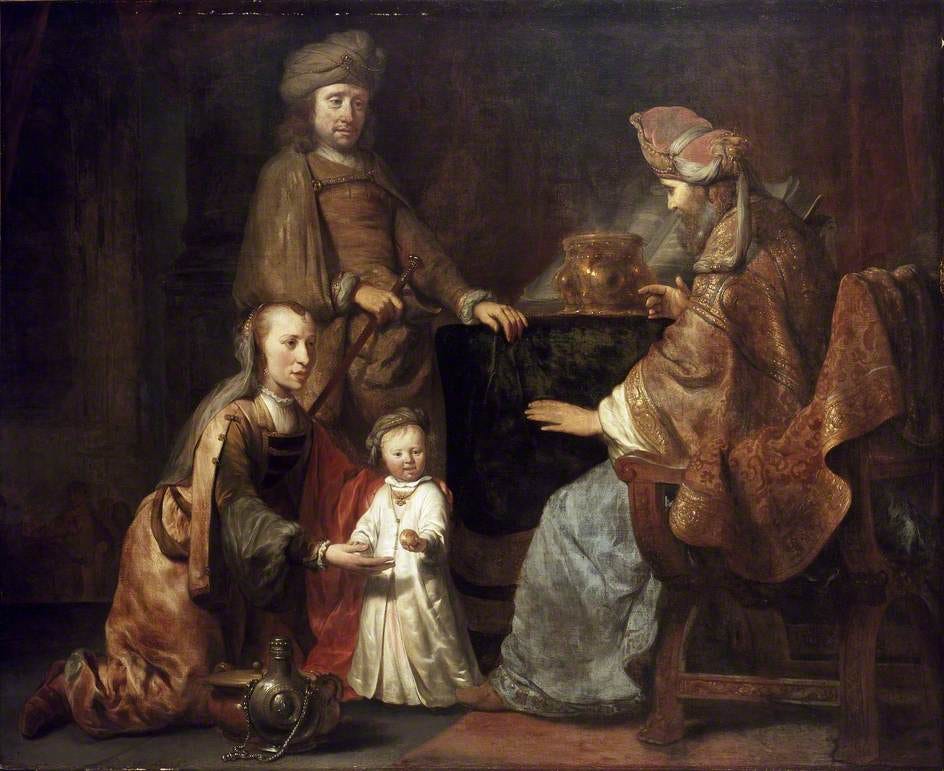
Above: Gerbrand van den Eeckhout, The Infant Samuel Brought by Hanna to Eli. Netherlands, 17th century.
Today’s Reading Plan:
There was a certain man from Ramathaim-zophim in the hill country of Ephraim whose name was Elkanah son of Jeroham, son of Elihu, son of Tohu, son of Zuph, an Ephrathite. He had two wives. The name of the one was Hannah, and the name of the other was Peninnah. Peninnah had children, but Hannah did not. Now that man used to go up year by year from his city to worship and sacrifice to Yahweh Warrior-God in Shiloh. And the name of the two sons of Eli were Hophni and Phineas, priests of Yahweh.
1 Samuel 1:1-3
For the rest of the month our Old Testament readings will come from 1 and 2 Samuel. These books describe the very end of the era of the judges as well as the reigns of the first two kings of Israel. They are in fact histories of the reign of those kings, written not too long after the events they describe. These are real, but still ancient, history books. We should take them seriously as works of history, but with the grains of salt required when reading any ancient history.
1 Samuel begins with a scene at the original shrine to Yahweh, in the town of Shiloh. The story follows the final priest of Shiloh, named Eli, and his young assistant named Samuel. We learn that Samuel’s mother had dedicated him to God as a child, in the repayment of a vow, so Samuel grew up at the shrine. By the end of today’s reading God will reject Eli’s family and condemn the shrine at Shiloh to destruction. Religious leadership over Israel will thus pass from Eli the priest to Samuel the prophet. This will be accomplished over the next few chapters, when God sends the Philistines to destroy the shrine.
These are real historical people and events, even if the stories told about them here were written much later. Samuel really was a prophet who worked near the old shrine at Shiloh, and that shrine really was destroyed in an attack by the Philistines around 1050 BC. It would be this war, as well, that led the Israelites to anoint their first king, as 1 Samuel will describe. So far this text has given a reasonably reliable account of the early history of Israel, just like a dramatized documentary might compose scenes that ultimately express a genuine truth.
I will continue to narrate the history of Israel alongside the progression of the narrative in the historical books. One final note for today, however. If you read 1 Samuel very closely, it is possible to discern a bit about the sources that the author used to compose this text. So, for example, it seems clear that the baby dedication scene was originally a scene for the dedication of king Saul, not the prophet Samuel. For some reason, the author of 1 Samuel has taken a story about Saul and simply replaced him with Samuel.
How do we know this? Because Hebrew texts love to include puns on names, especially in birth stories. And 1 Samuel 1 makes many, many puns based on Saul’s name. “Saul” in Hebrew means “to ask” and is pronounced like “sha-ool.” Over and over and over throughout chapter one there are puns on the name “Saul.” So, for example, at one point Hannah says, “I prayed for this child, and Yahweh has given me the ask (sha-ool) that I have asked (sha-ool) from him” (1:27). This is most obvious in verse 20, which describes the naming of the promised child—when a pun would be most expected. The text says that Hannah “called his name Samuel (shmoo-el), ‘because I asked (sha-ool) him from Yahweh’” (1:20).
It seems clear that, for whatever reason, the original text described Saul at the shrine in Shiloh, rather than Samuel. This is a good reminder that historical books in the Bible are themselves based on pre-existing sources, and it is sometimes possible to discern the traces of those sources even within the surviving final text. This allows us to reconstruct both the history of ancient Israel as well as the history of the historical texts themselves, if we are patient and diligent in our study.