
Daily Reading - 5/6/26
1 Kings 11:1-4
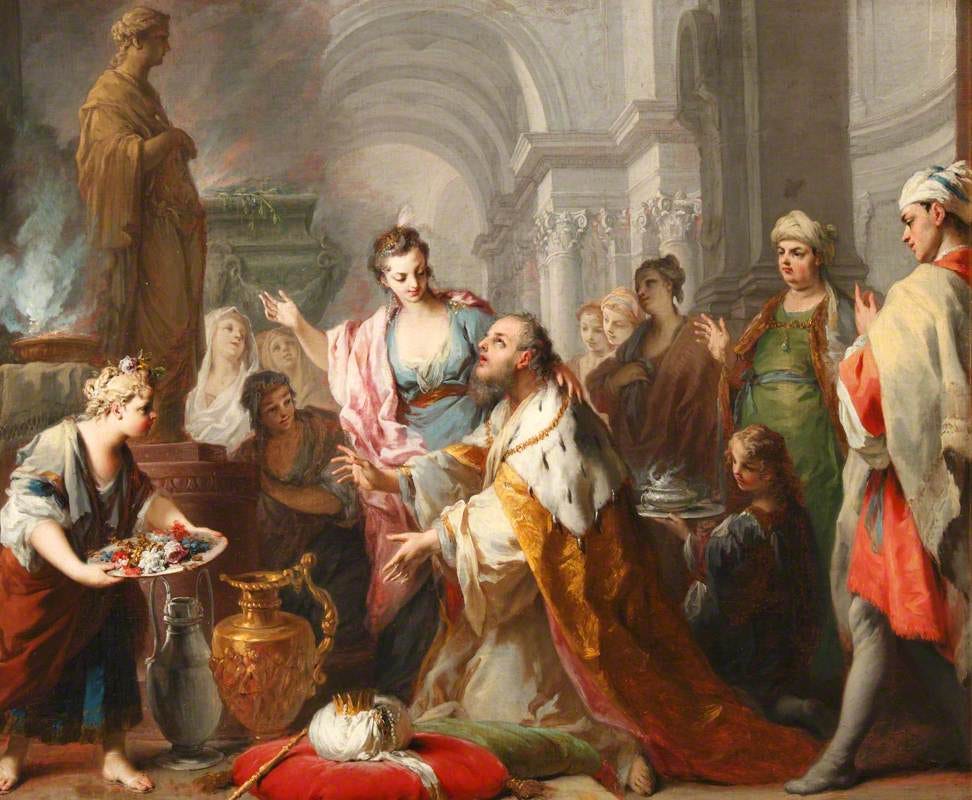
Above: Jacopo Amigoni, Solomon Sacrificing to His Wives’ Idols. Italian (in England), 1729.
And the king Solomon loved many foreign women besides the daughter of Pharaoh: Moabites, Ammonites, Edomites, Sidonians, Hittites, from the nations about which Yahweh had said to the sons of Israel: “Do not intermarry with them or them with you, for they will surely turn your hearts away after their gods.” Solomon clung to these in love. He had 700 royal wives and 300 concubines. And his wives turned away his heart. It happened that when Solomon became old, his wives turned away his heart after other gods, and his heart was not wholly with Yahweh his god as David his father’s heart had been.
1 Kings 11:1-4
In today’s reading we learn about the apex and then decline of the Israelite monarchy. It begins in chapter 10 with a glowing account of the power, wealth, and prestige of the kingdom under Solomon. As usual, the text tells us this in two complementary ways. First there is a fun and memorable, “narrative” rather than “annalistic,” story about Solomon’s encounter with the Queen of Sheba (probably modern Yemen). This story is told in 10:1-13. After this dramatic depiction of Solomon’s wealth comes a dry, but more historically reliable, “annalistic” account that expresses essentially the same idea: Israel was rich during Solomon’s reign (10:14-29).
After that glowing account of Solomon’s reign, the author begins to describe the decline of the Israelite kingdom. It began, according to the author, in Solomon’s bedroom. We are told that Solomon married “many foreign women.” Very many, in fact. According to the text, Solomon had 700 noble wives and 300 slave wives (concubines). Was this because Solomon was history’s most lustful monarch? In part, maybe. But the majority of his wives served a political rather than simply personal function.
The Bible contrasts David and Solomon as the warlike and peaceful kings. According to 1 Chronicles 28:3, God did not allow David to build the Temple because he was a “man of blood.” By contrast, the name “Solomon” comes from “shalom” (peace). The origin of David’s reputation is obvious. As we have seen, he was indeed a “man of blood.” But Solomon’s reputation requires a bit more explanation.
Solomon’s reputation as a wise ruler is connected to his peaceful legacy. Part of the reason for his reputation as a wise man came from the scholarly activities sponsored by his court, but another large part of it came from his less aggressive geopolitical strategy. David had built the Israelite empire through war, but Solomon maintained it through diplomacy. Instead of using swords, he used words. This stable empire is also what gave Israel under Solomon its profound wealth.
In the ancient world, diplomatic relations between states were understood as large-scale interpersonal relationships. So, for example, two kings of equal nations would describe each other as “brother” in their letters, while a superior and inferior king would describe each other as “father” and “son.” This was also, indeed, sometimes literally true. Most alliances in the ancient world (and up until modernity, in fact) were arranged through royal marriages. The idea is that if I marry your daughter, neither of us is likely to attack the other’s country. Why would you attack your own family member, potentially even putting your own daughter’s life at risk?
Thus Solomon’s 700 noble wives each represent one of these royal marriages. The ultimate purpose was neither love nor lust, therefore, but geopolitics. And this, we are told, led to the Israelites’ downfall. Though the compromise led to security and wealth during Solomon’s reign, it also introduced the worship of foreign gods into Israel.