
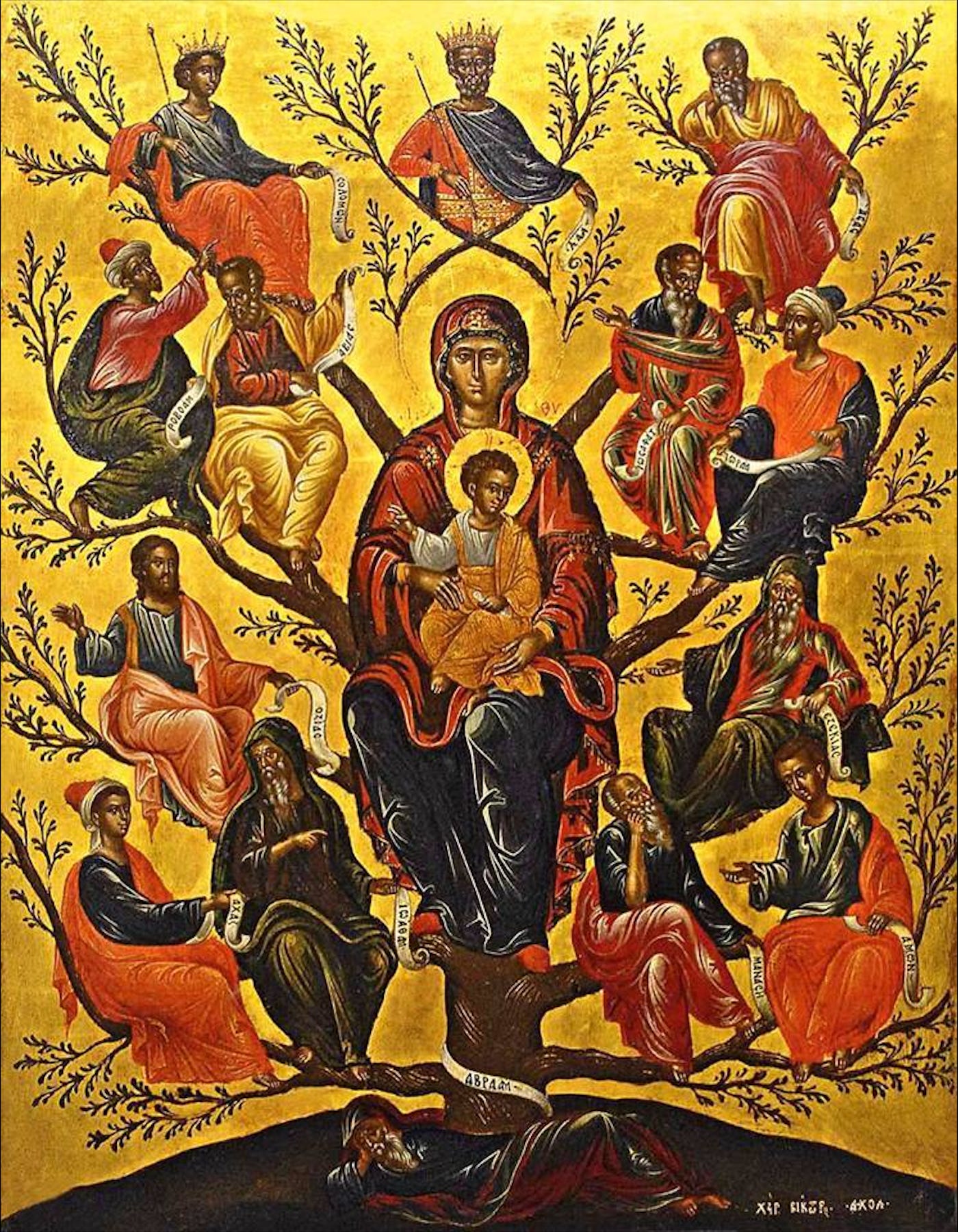
Above: Viktor. Tree of Jesse. Crete, 1674. Notice that Christ emerges as a “branch” from the “tree,” whose root is Abraham (the sleeping figure).
“Behold, the days are coming,” declares Yahweh, “When I will fulfill the promise that I made with the house of Israel and the house of Judah. In those days and in that time I will cause a righteous branch to spring up for David, and he shall execute justice and righteousness in the land. In those days Judah will be saved, and Jerusalem will dwell securely, and this will be the name by which it is called: “Yahweh is our righteousness.”
Jeremiah 33:14-16
In today’s reading we encounter another prophecy that would eventually be fulfilled in the birth of Jesus. We are told that the prophecy of chapter 33 came to Jeremiah when he was imprisoned in Jerusalem (33:1). He had been imprisoned during the final siege of Jerusalem of 586 by king Zedekiah (32:1-6), as punishment for his prediction that Babylon would defeat Judah (though cf. 37:11-21).
Jeremiah had not only predicted defeat, however. Jeremiah predicted that God would hand over Judah to Babylon, but that after two generations God would liberate them once again. Chapter 33 thus begins with Jeremiah symbolically purchasing a field. This would have seemed ludicrous to someone in his time. Why, with the Babylonians literally at the gates besieging the city, was Jeremiah looking to increase his acreage? A rational person would not invest in building a factory if they knew their city would be carpet-bombed the next day.
But Jeremiah purchased a field to demonstrate God’s promise that one day the Israelites would return to Judah. So God instructed Jeremiah to make a long-term investment. The sealing of the contract itself was a prophetic action, declaring that the Judeans would indeed return. Thus Jeremiah duly collected the necessary documents and stored them in an airtight container to prevent decay (32:14-15).
In chapter 33, while Jeremiah was still in prison, he received another prophecy. That prophecy reaffirmed God’s promise to the Israelites, that he would one day restore them. But as we have seen, these prophecies seem to aim at a higher and loftier goal than simply the restoration of one nation-state.
First God promises to forgive the Israelites’ sins (33:8). The language of “cleansing” here probably implies not only forgiveness, but also transformation. God will forgive them of sin and then change them so that they will no longer sin. A bit later the prophecy begins to more clearly anticipate Jesus. It says that one day God would “cause a righteous branch to spring up for David” (33:15). What this means is that one day God would raise up a new king from the dynasty of David to rule over a reunited and restored Israel.
The reason that the future king is called a “branch” is that the dynasty of David was becoming defunct within Jeremiah’s own time. This prophecy was given in the last days of king Zedekiah, the final king of Judah. After Zedekiah, the Davidic dynasty was ended. But not forever, we are told. Jeremiah promised that the felled stump of the Davidic dynasty would one day produce a new branch. That “branch” would then be a heroic and righteous king, who would lead to a new era of peace and prosperity in a restored Israel (33:14-16).
The text then makes a curious claim. It claims that the throne of David would last forever, and that the priests of the Jerusalem temple would remain active forever. This is a very strange prophecy, since Jeremiah himself saw the kingdom toppled and the temple destroyed. But if we think about this prophecy in the context of later salvation history, it begins to make sense. According to the New Testament, Jesus was not only the true king of Judah but also its high priest (Heb. 11-28). That Jeremiah insists that these will last “forever” seems to clearly anticipate its final culmination in Jesus.