
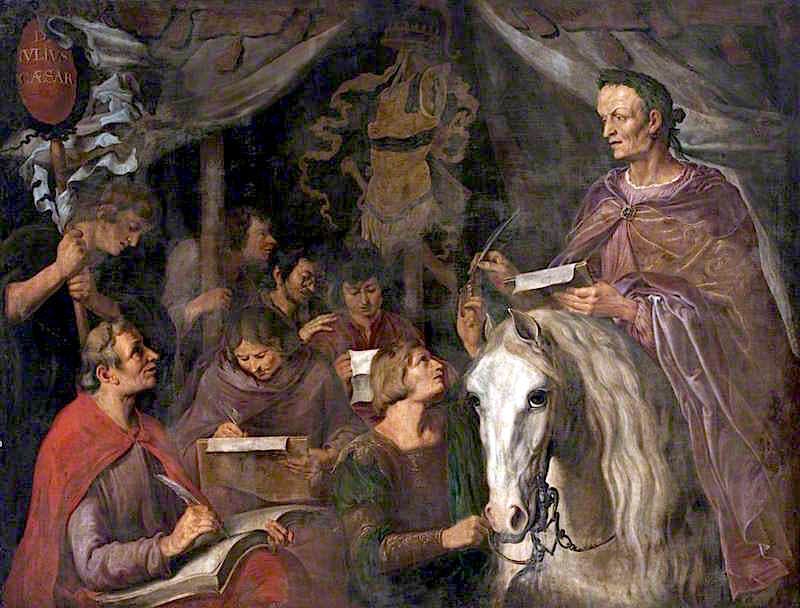
Above: Jaques de Gheyn II. Julius Caesar on Horseback, Writing and Dictating Simultaneously to His Scribes. Netherlands, 1629. This painting depicts a boast about Caesar during his own time, that he was so adept at multitasking that he “dictated” different writings to multiple scribes at once. The same claim was also made about the early Christian theologian Origen.
And it happened in the fourth year of Jehoiakim son of Josiah, king of Judah, that this word came to Jeremiah from Yahweh, saying, “Take a scroll and write on it all the words that I have spoken to you about Israel and Judah and the nations, from the day I spoke to you, from the days of Josiah, until today. Perhaps the house of Judah will hear all the evils that I intend to do to them, so that everyone might turn from his evil way, and that I may forgive their iniquity and sin.”
Jeremiah 36:1-3
In today’s readings we encounter a memorable scene from Jeremiah’s career. Chapter 36 contains one of the only stories describing how a prophetic text was written. Though the story does not depict a prophetic book being written and preserved for posterity, it may at least shed some light on how prophetic books were originally composed.
First, we are told that Jeremiah was instructed to write a scroll of prophecies. This scroll was supposed to contain all of Jeremiah’s prophecies up to that point. If the scroll was written in “the fourth year of Jehoiakim” (36:1), that would have been around 605 BC. If, as we have assumed, Jeremiah became a prophet in 626 BC, that would mean that the scroll contained the last 21 years worth of prophecies.
Though God had told Jeremiah to “take a scroll and write on it,” that is not precisely what Jeremiah did. Instead he called his scribe Baruch and dictated the prophecies to him (36:4). This is a small but crucial point. In the ancient world, into the New Testament era and beyond, the “writer” of a text was not necessarily the one who held the pen and scratched it on some paper. The “author” was, rather, the originator of the ideas of the text. Typically the author then contracted a scribe who did the actual writing.
That distinction is important because there was a spectrum of degrees to which a scribe might be involved in the writing process. At one end of the spectrum, as seems to be the case here, an “author” might dictate a text and a scribe would copy it down word-for-word (cf. 36:4). At this extreme, the scribe was merely a human typewriter. At the other end of the spectrum, though, a scribe might be intimately involved in the actual composition of the text. Sometimes an “author” might simply tell the scribe what idea to communicate, and then the scribe figured out how to translate that idea into an eloquent text.
This exploration of scribal practices matters to us because of the light it shed on biblical books. Both in the Old and New Testaments there are books that sit on various points of this spectrum of authorship. The Apostle Paul, for example, casually mentions his own use of scribes when he wrote his letters (cf. Rom. 16:22). The story of Jeremiah’s dictation to Baruch is the only similar piece of evidence for how Judean prophecies moved from oral prophecy to written prophecy. Though the text was burned by the king (36:20-26), Jeremiah must have made other copies, since something like that text must have provided the basis for the book of Jeremiah itself.