
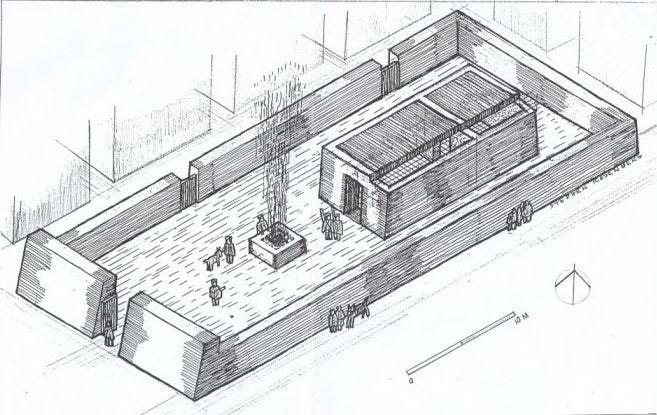
Above: Stephen Rosenberg. Diagram of the Jewish temple at Elephantine.
Therefore thus says Yahweh of armies, god of Israel, “Behold, my face is set against you for harm, to cut off all Judah. And I will take the remnant of Judah who have set their faces to come to the land of Egypt to sojourn there. And they will be consumed in the land of Egypt; they will fall by the sword, they will be consumed by famine. From the least to the greatest they will die by sword and famine. They shall be an oath, a horror, a curse, and a taunt.”
Jeremiah 44:11-12
In today’s reading we conclude the main body of the book of Jeremiah. We have followed Jeremiah from the beginning of his prophetic career in 626 BC through the turbulent final years of the kingdom of Judah and beyond. After it was destroyed in 586 BC, some Judeans fled to Egypt, forcibly taking Jeremiah with them. And so, at the end of the book, the prophet gives his final bitter condemnation of the Judeans in Egypt.
We learn in 44:1 that Jeremiah addressed his prophecy to those Judeans who lived in Midgol, Tahpanhes, Memphis, and Pathros. These were cities or regions of Egypt to which the Judeans had fled as refugees. Jeremiah condemned these exiles because they had apparently continued worshipping pagan gods even after the destruction of Jerusalem. The prophet said that the Judean women, with the approval of their husbands, had been worshipping the “queen of heaven” (44:24-30). This goddess is known elsewhere in the Bible and ancient world alternatively as Inanna, Ishtar, Astarte, and Asthoreth.
The worship of Ashtoreth was very deeply rooted in Judean practice. It was, indeed, present at the very beginning of the Israelite nation. We are told that after the Exodus, during the era of the judges, that the Israelites went astray and worshipped many foreign gods. The book of Judges specifically tells us that they worshipped “Ba’al and the Ashtoreths” (Judges 2:13). That text describes Israelite history around 1200-1150 BC. This means that the Judeans had worshipped the “queen of heaven” in an almost unbroken succession for around 600 years. Jeremiah was condemning a truly ancient, deeply rooted practice.
The core of Jeremiah ends on that tension-filled note. God’s climactic punishment had finally come, destroying the kingdoms of Israel and Judah and scattering their inhabitants among the nations. But even far away in exile, as refugees in Egypt, the Israelites continued to practice their heinous sins. They continued to worship foreign gods—the very reason God had sent the disaster in the first place. The core of the book ends in chapter 45, where God promises to protect Baruch, the scribe who wrote the book. We should consider that the dramatic end to the narrative. We will discuss the remainder of the text in future days.
There is dramatic archaeological confirmation of this prophecy. We know for a fact that there was a Jewish temple in the region of Pathros, on the island of Elephantine, that practiced polytheism. The ruins of the temple at Elephantine and the documents relating to it make clear that those Jews worshipped Yahweh alongside a goddess named Anat, who was sometimes (and later permanently) conflated with Asthoreth. We thus have direct, independent evidence of Jeremiah’s claim.
The story of the polytheistic Jewish temple at Elephantine is very strange, though. Because of the surviving documents, we know that the priests of the Elephantine temple became allied by marriage to the leadership of the temple in Jerusalem. In 410 BC the priests of the Egyptian god Khnum bribed a Persian military officer to burn down the Jewish Elephantine temple. The Elephantine Jewish leaders responded by appealing for help to the Jerusalem Jewish leaders, asking for help rebuilding the temple. They agreed, as did Sanballat governor of Samaria (mentioned in Nehemiah).
This history not only sheds light on the prophecies of Jeremiah, but also helps us to understand the nature of early “Judaism”—which around this time emerged out of classical Judean religious practices. This background shows us that even after the exile of 586, and even as late as the 300s, the Judeans-turned-Jews were still worshipping foreign gods alongside Yahweh. Even after the rebuilding of the temple in 516 BC, they still did not have the Law written on their hearts (Jer. 31:31-34). That promise would not be fulfilled until the birth of Jesus, who taught the true and authoritative interpretation of the worship of Yahweh.